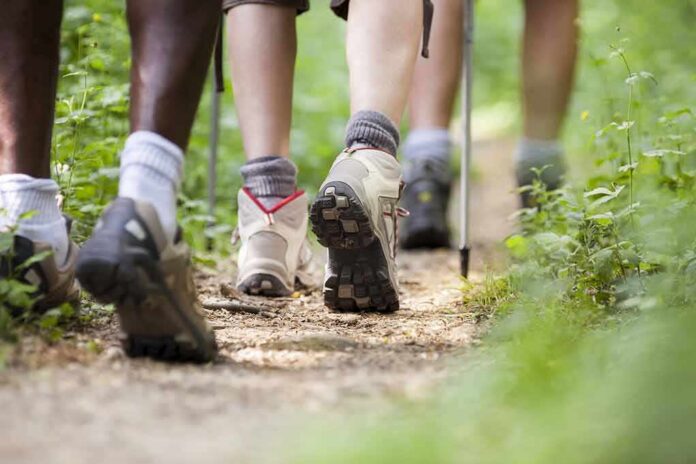
A brisk 40-minute walk, done three or four times a week, may do more for your memory than any supplement on the shelf.
Quick Take
- UCLA psychologist Dr. Alan Castel told podcast host Dr. Andrew Huberman that regular walking can boost hippocampal function, the brain region tied to memory.
- Castel points to a randomized study comparing walkers to stretchers, with walkers scoring better on memory tests up to a year later.
- Some reports describe the walking group’s hippocampus growing in size rather than shrinking, which is the normal pattern with age.
- Broader research on exercise and brain health shows real benefits, though not every study agrees on exactly how much the hippocampus grows.
The Study Castel Says Backs Up the Walking Habit
Dr. Alan Castel, a psychology professor at the University of California, Los Angeles (UCLA), laid out the case on the Huberman Lab podcast. He described a trial where older adults were randomly split into two groups. One group walked three or four times a week for about 40 minutes. The other group did stretching instead.
According to Castel, the walking group outperformed the stretching group on multiple memory tests. That advantage reportedly held up for a full year after the program started. He has repeated similar numbers in other interviews, pointing to the same study design as his go-to example of exercise changing the brain.
Other outlets covering Castel’s broader research describe the same 2011-era trial, noting that walkers were tracked at six months and again at the one-year mark. Each time, the walking group showed a measurable edge over the stretching group on memory outcomes tied to brain scans.
Castel ties the memory gains to the hippocampus itself, the horseshoe-shaped structure deep in the brain that handles the kind of memory used to recall facts, names, and events. One summary of the Huberman Lab conversation claims walking did not just slow the hippocampus from shrinking with age. It says the structure actually grew by about one percent over a year, reversing the usual decline.
Why the Hippocampus Gets So Much Attention
The hippocampus naturally loses volume as people age, and that shrinkage is linked to the kind of memory slips most people brush off as “senior moments.” A UCLA paper co-authored by Castel cites earlier research showing that walking for an hour several times a week can enhance the size of this brain region, framing it as one of the most accessible tools against age-related decline.
What the Wider Research Actually Shows
Zoom out from Castel’s specific study and the picture gets more layered. A meta-analysis pooling data from multiple hippocampal volume trials found no statistically significant increase in hippocampus size from aerobic exercise programs, even though those same programs improved participants’ cardiovascular fitness. Another review of fourteen randomized trials found exercise produced only a small benefit for verbal fluency, with no significant improvement for memory specifically.
That does not mean exercise is useless for the brain. A large Bayesian analysis of thirty-eight randomized trials found aerobic workouts, resistance training, and combined programs all significantly improved cognition compared to doing nothing at all. The disagreement among researchers is less about whether movement helps and more about how much, through which exact mechanism, and for which group of people.
The Practical Takeaway for Readers Over 40
Walking costs nothing, requires no gym membership, and carries almost no injury risk compared to harder workouts. Even if scientists keep debating the exact size of the hippocampal effect, the broader evidence consistently links regular movement to better brain function in older adults. That is a low-risk, high-reward habit worth building into daily life regardless of which study wins the argument.
Common sense has said for generations that a daily walk clears the head and steadies the mind. Modern brain scans are now putting numbers behind that old wisdom, even if researchers still argue over the decimal points. For readers weighing whether to lace up their shoes today, the honest answer from the data is simple: it almost certainly cannot hurt, and it likely helps.
Castel’s larger message, echoed across his UCLA work and his Huberman Lab appearance, is that aging brains are not doomed to decline on a fixed schedule. Lifestyle choices, walking chief among them, appear to shift that trajectory. That is a far more hopeful note than most aging research offers, and it comes with instructions anyone can follow starting this afternoon.
Sources:
youtube.com, allamericanspeakers.com, castel.psych.ucla.edu, crazystack.com.br, yolongevity.com, pmc.ncbi.nlm.nih.gov, pubmed.ncbi.nlm.nih.gov