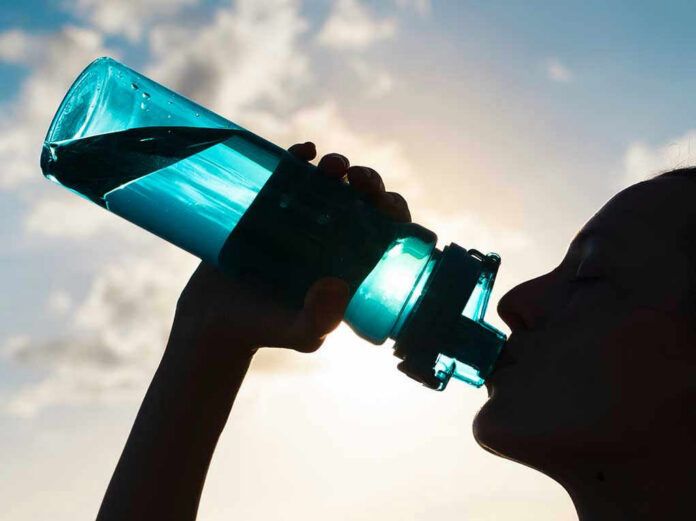
Chugging water during your workout might not be the performance boost decades of advice promised. A new review of 24 studies found no clear proof that drinking fluids during exercise makes you finish faster or work harder.
Quick Take
- A review of 24 randomized trials with 225 people found no clear performance boost from drinking during exercise.
- Official sports medicine guidance still says fluid matters, but mainly to prevent serious dehydration, not to maximize performance.
- Overhydration carries its own danger, including a condition called exercise-associated hyponatremia.
- Expert advice now leans toward small, steady sips tied to actual sweat loss rather than drinking as much as possible.
What The New Review Actually Found
Researchers pooled data from 24 randomized trials covering 225 participants. They looked at whether drinking fluids during exercise improved time-trial finishes or the amount of work people completed in a set time. The result surprised many coaches: no clear advantage showed up for either outcome. Evidence that drinking might delay exhaustion existed, but the review called it too uncertain to confirm.
That finding does not erase decades of hydration science. It simply narrows the claim. Drinking fluids clearly matters when you are losing a lot of sweat over a long time, especially in heat. The data gets shakier for shorter or more moderate efforts, where the body already holds enough reserve to perform without a mid-workout water break.
Why The Old Guidance Still Gets Repeated Everywhere
The American College of Sports Medicine’s long-standing position stand set the tone for most hydration advice heard today. Its real goal was preventing body-weight loss beyond two percent and avoiding dangerous electrolyte swings, not promising faster race times. That distinction got lost somewhere between the lab and the locker room, where “drink water” turned into a blanket performance rule instead of a safety guardrail.
Performance scientist Andy Galpin has pushed back on the oversimplified version of this advice. He recommends roughly three to six ounces every fifteen to twenty minutes for most people, not constant guzzling, and stresses that electrolytes matter just as much as plain water. His bottom line is blunt: water alone is not enough, and more is not automatically better.
The Overhydration Risk That Gets Ignored
Drinking too much during long exercise carries a real medical risk called exercise-associated hyponatremia, where sodium levels in the blood drop dangerously low. Research shows the main cause is simple: drinking more fluid than you actually lose through sweat. A 2015 international consensus on the condition recommended athletes drink according to thirst instead of chasing a fixed fluid target, a shift that directly challenges the old “drink before you’re thirsty” rule many runners grew up hearing.
A separate review of endurance rehydration backs up the idea that moderate fluid loss is not automatically a performance killer. It found that losing one to three percent of body weight in water was less likely to hurt endurance performance than losing four to seven percent, meaning the two percent threshold often cited as a hard cutoff does not apply evenly across every sport, distance, or climate.
What This Means Before Your Next Workout
None of this means water is useless or that dehydration is harmless in real heat over a long race. It means the blanket advice to drink constantly deserves more scrutiny than it usually gets from coaches, trainers, and sports drink marketing. Matching fluid intake to actual sweat loss, duration, and heat makes more sense than treating every workout like a marathon in July.
Common sense still applies here. Listen to thirst, pay attention to electrolytes on long hot days, and treat “drink more water” as a starting point rather than a performance guarantee backed by solid science. The research increasingly says moderation and context beat a one-size-fits-all water bottle rule.
Sources:
mindbodygreen.com, health.yahoo.com, onlinelibrary.wiley.com, pmc.ncbi.nlm.nih.gov