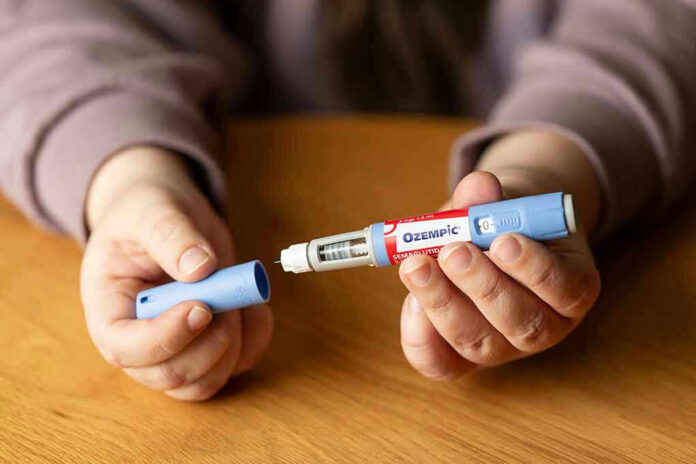
A new government-funded study says the shot that shrank your waistline probably didn’t fix your marriage, your mood, or your job.
Quick Take
- A 2026 National Bureau of Economic Research (NBER) working paper found GLP-1 drugs like Ozempic showed no meaningful link to better mental health, employment, or marriage among diabetes patients.
- The study tracked outcomes at one and two years and found the same result both times.
- Some estimates leaned positive, including a small bump in work and marriage odds, but none were statistically solid enough to call real.
- Celebrities and everyday patients keep reporting big life changes, creating a gap between hard data and personal stories.
What The New Study Actually Found
Researchers set out to answer a simple question. Does losing weight and controlling blood sugar on a GLP-1 drug change the rest of a person’s life? The National Bureau of Economic Research working paper 35198 studied adults with diabetes and found no meaningful connection to mental health, self-rated health, employment, or marriage. The physical numbers still looked good. The life numbers barely moved.
A University of Chicago summary of the same research put it plainly. Scientists found little evidence that GLP-1 use led to measurable changes in mood, health perception, jobs, or marital status. That holds true whether patients had been on the drug for about a year or for two years, meaning this isn’t a case of needing more time to see results. The pattern repeated itself across both time frames.
The Numbers Weren’t All Zero, Just Not Proven
Buried in the data is a detail worth noting. GLP-1 users showed a 4.6 percentage point increase in the odds of working and a 6.7 percentage point jump in the odds of being married. Neither number cleared the bar scientists use to call a result real rather than random noise. That means the drug might help in these areas, but the current study can’t prove it. It’s a maybe, not a no.
This distinction matters for anyone reading headlines and assuming the science is settled. A ScienceDaily summary described the situation well, noting GLP-1 drugs clearly improve blood sugar, weight, and heart health, but the researchers found little evidence they also lift mental health, jobs, marriage, or overall well-being. Physical gains are locked in. Life gains remain unproven, not disproven.
Why Celebrities Tell A Different Story
Oprah Winfrey has said the medication leaves her feeling calmer and stronger. Amy Schumer has credited it with better energy and improved perimenopausal symptoms. Shaquille O’Neal says it helped his sleep and energy after years battling sleep apnea. These are real people describing real experiences, and dismissing them outright would be unfair.
Everyday patients echo similar stories. One man told Thrive Global the drug gave him more energy for his family and even helped him save money. A woman named Emma Wallwork said weight loss gave her the courage to try pole dancing and left her feeling far more positive about herself. These accounts are personal and specific. They simply aren’t the same thing as a controlled scientific study measuring average effects across thousands of people.
Reading The Gap Between Data And Anecdote
Here’s the honest tension. Individual testimonials can be true while a population-level study still finds no measurable average effect. A handful of dramatic stories doesn’t cancel out data from a large diabetes sample, and a null study doesn’t erase what one person genuinely felt. Both things can exist at once, and pretending otherwise insults the reader’s intelligence.
What Broader Research Suggests
This isn’t an isolated finding. A World Health Organization expert review found GLP-1 drugs clearly help with weight loss and waist size, but described quality-of-life improvements as minimal. Other large reviews of semaglutide found little to no meaningful difference in cardiovascular events, death rates, or quality of life compared to placebo, even while weight loss numbers stayed impressive. The pattern keeps repeating across different research teams and different datasets.
The honest takeaway for conservative-minded readers skeptical of hype is straightforward. These drugs do real, measurable work on the body. Blood sugar improves. Weight drops. Heart risk factors get better. But claims that a pill or injection will also fix your career, your marriage, or your mental state deserve the same scrutiny we’d apply to any other miracle promise. The body can change. Life requires more than a prescription.
None of this means GLP-1 drugs are a bust. It means the marketing has outrun the evidence on anything beyond the physical. Patients considering these medications should weigh them for what science actually confirms, weight and metabolic health, and stay cautious about promises the data simply doesn’t back up yet.
Sources:
sciencedaily.com, harris.uchicago.edu, era-online.org, media.springernature.com, wiareport.com