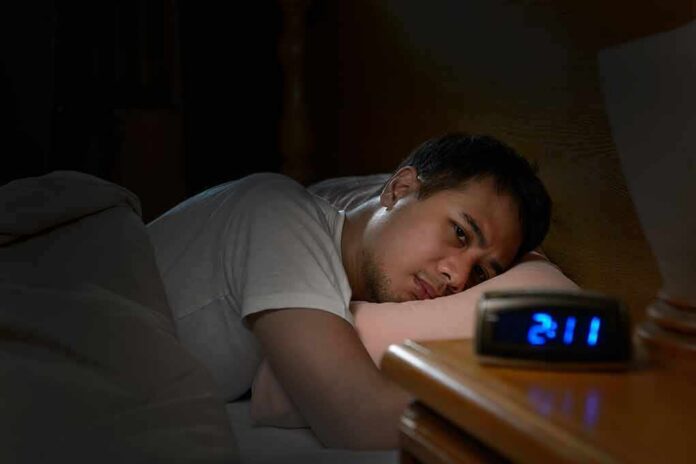
Men’s sleep quality takes a measurable hit after age 40, and scientists have a number to prove it: sleep efficiency, the percentage of time in bed actually spent asleep, drops by roughly 3% every decade once that birthday hits.
Quick Take
- Sleep efficiency, the share of time in bed spent actually sleeping, declines by about 3% per decade starting at age 40.
- Older adults also take longer to fall asleep and wake up more during the night, according to objective sleep studies.
- Not every study agrees on the pattern, and personal health, medications, and sleep disorders change the picture.
- Sleep hygiene habits like steady wake times and cutting late caffeine help, but they don’t replace treatment for real insomnia.
What Sleep Efficiency Actually Measures
Sleep efficiency sounds technical, but it’s simple math. Researchers divide total time asleep by total time spent in bed. A person who lies in bed for eight hours but only sleeps six has a sleep efficiency of 75%. Scientists treat this number as one of the most reliable signs of sleep quality, because it captures fragmented, restless nights that a simple “hours slept” count would miss entirely.
A 2019 population study found that sleep efficiency “decreases clearly and significantly with age” across a large sample of adults. That decline isn’t a sudden cliff. It builds slowly, showing up first as more frequent nighttime wake-ups and a harder time drifting off, long before a person notices daytime fatigue.
The Research Behind the Age-40 Marker
The age-40 figure traces back to the Massachusetts Male Aging Study, a landmark project tracking men’s health over time. It found sleep efficiency fell by about 3% per decade starting after age 40. A newer 2024 study backed that up, linking older age to lower sleep efficiency, longer time falling asleep, and more time lying awake after first drifting off, even after accounting for common health problems.
Those findings line up with decades of sleep lab data. As the body ages, deep sleep stages shrink and the brain rouses more easily from noise, discomfort, or a full bladder. None of this means a man crosses some biological switch the day he turns 40. It means the odds of fragmented sleep climb steadily from that point forward.
Why Some Studies Show a Different Pattern
Science rarely hands over a tidy, universal rule, and sleep research is no exception. One 2021 polysomnography study actually found younger men had lower measured sleep efficiency than older men in that particular sample. That doesn’t erase the broader pattern, but it’s a fair reminder that sex, weight, sleep apnea, medications, and even how a study measures sleep all shift the results.
Translation for the average guy: the age-40 marker is a strong, well-documented trend, not an ironclad guarantee. Genetics, fitness level, alcohol habits, and existing health conditions all play a role in whether a given man’s sleep holds steady or starts slipping.
What Doctors Recommend Instead of Guesswork
The American Academy of Sleep Medicine offers straightforward, evidence-backed advice: wake up at the same time every day, including weekends, skip caffeine after lunch, and avoid alcohol within four to six hours of bedtime. The group also notes alcohol frequently triggers middle-of-the-night awakenings, undercutting the common belief that a nightcap helps sleep.
These habits matter, but they have limits. The same academy’s clinical guidelines state there isn’t enough evidence that sleep hygiene alone fixes real insomnia. Lifestyle tweaks are a smart baseline, not a cure for a diagnosed sleep disorder.
Separating Normal Aging From a Sleep Disorder
A tired, restless 45-year-old shouldn’t assume age alone explains every bad night. Sleep apnea, restless legs syndrome, chronic pain, and certain medications all mimic ordinary age-related decline, but each needs its own treatment. Chasing a better bedtime routine won’t fix an untreated breathing disorder, and only a doctor can tell the difference between normal aging and something that needs real medical attention.
The honest takeaway here is common sense, not panic. Sleep naturally gets choppier with age, and the data backs that up clearly. But men who notice serious, persistent trouble sleeping should talk to a doctor rather than assume it’s just the calendar catching up with them.
Sources:
menshealth.com, academic.oup.com, pmc.ncbi.nlm.nih.gov, onlinelibrary.wiley.com, aasm.org, selfhacking.com, tandfonline.com, link.springer.com