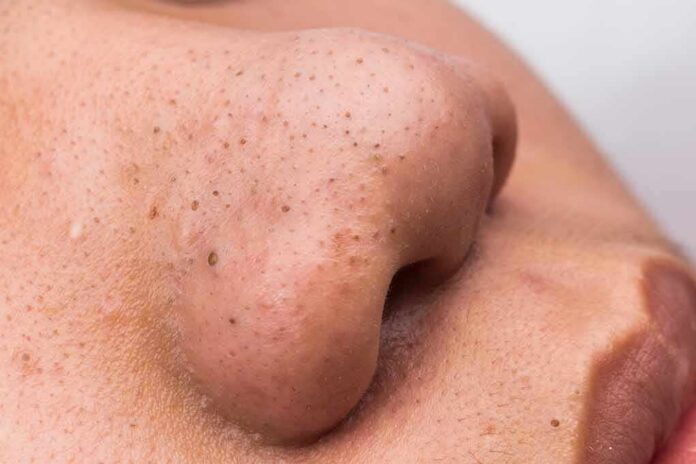
Nearly 229,000 adults just gave scientists a clear answer about whether what’s on your plate shows up on your face.
Quick Take
- A King’s College London study of 228,757 adults found Mediterranean-style eating lowered the odds of current acne.
- Researchers used UK Biobank data, finding 1,603 people with current acne and 5,709 with a history of it.
- The protective link showed up most strongly among women, according to reporting on the findings.
- This fits decades of smaller studies tying high-sugar, high-dairy Western diets to worse breakouts.
The Numbers Behind The Study
Researchers pulled data from 228,757 adults between ages 37 and 73 using the UK Biobank, a massive health database. Among them, 1,603 people, or 0.7 percent, had active acne. Another 5,709 reported having had it in the past. That’s one of the largest groups ever studied for this question, giving the findings real statistical weight.
The team measured how closely each person’s eating habits matched a Mediterranean diet. Think olive oil, fish, vegetables, whole grains, and less processed meat and sugar. People who scored higher on that scale had lower odds of having acne right now, with researchers calculating an adjusted odds ratio of 0.93. That’s a modest but statistically real effect, not a dramatic cure.
How Mediterranean Eating Stacks Up Against Acne
The connection was not uniform across everyone studied. Reporting on the research noted the protective effect showed up more clearly in women than in men, a detail that lines up with how hormones and skin oil production differ between the sexes. Acne in adult women is already known to behave differently than teenage acne, often tied to hormonal shifts rather than diet alone.
It is worth being honest about what this kind of study can and cannot prove. This was a cross-sectional snapshot, meaning researchers compared diet and skin at one point in time rather than tracking people for years. That design can show a pattern exists, but it cannot prove the diet directly caused clearer skin.
Decades Of Diet-Skin Research Back This Up
This finding doesn’t stand alone. A review of acne-diet research from 2009 to 2020 found 53 separate studies, though only 11 were actual clinical trials and 42 were observational. That imbalance matters. Observational studies can spot a connection, but trials are what actually test cause and effect, and the field has leaned heavily on the weaker kind of evidence for years.
Earlier research backs the general direction, even if the details vary. A French study of 24,452 adults found that eating fatty, sugary foods and drinking milk was linked to higher rates of adult acne. Other reviews point to high glycemic index diets, foods that spike blood sugar fast, as a repeated trigger across multiple studies and even some randomized trials.
What This Means For Your Dinner Plate
Not every study agrees on how strong the Mediterranean diet’s effect really is. A separate meta-analysis found no statistically significant link between following the diet and whether someone develops acne in the first place, though it did find a connection to less severe breakouts once acne was already present. The signal is real, but its size stays debated.
Taken together, the evidence doesn’t hand anyone a miracle skincare routine hiding in the produce aisle. But it does back up something common sense already suggested. Less sugar, less processed junk, and more real food tends to help the body in ways that show up on the skin, not just the scale. That’s a message worth more attention than another overpriced serum.
Sources:
mindbodygreen.com, onlinelibrary.wiley.com, pmc.ncbi.nlm.nih.gov, pubmed.ncbi.nlm.nih.gov