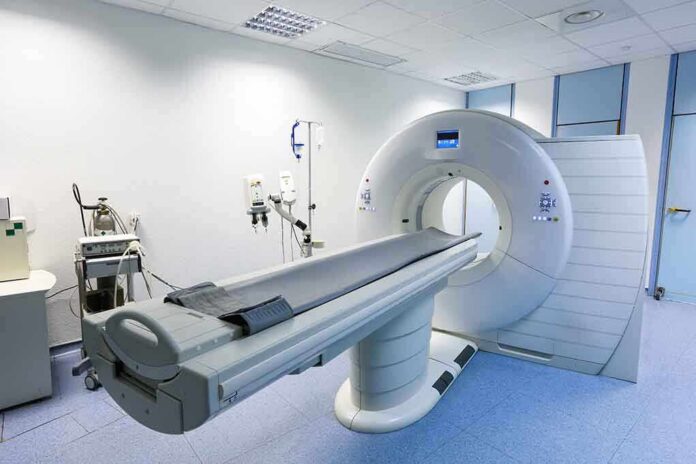
A whole-body MRI can scan nearly every organ in your body in under an hour, but the odds it finds an actual cancer are closer to one in 65 than one in ten.
Quick Take
- Baseline whole-body MRI scans, sold by companies like Prenuvo, promise early detection of hundreds of conditions without radiation.
- A 2026 meta-analysis found a pooled confirmed cancer detection rate of just 1.57 percent among asymptomatic people scanned.
- Studies show up to 94 percent of healthy people get at least one abnormal finding, most of which lead nowhere.
- Major medical groups, including the American College of Radiology, say there is not enough evidence these scans help people live longer.
What The Scan Actually Promises Buyers
Prenuvo markets its scan as a tool that can screen for hundreds of conditions across the whole body in under an hour, with no radiation or contrast dye needed. The company’s own FAQ page is careful to say the scan is not meant to replace mammograms, colonoscopies, or other guideline-based screening tests. That distinction matters. It positions the scan as an add-on, not a substitute, for the screening your doctor already recommends.
Prenuvo also points to its own internal follow-up project, called Polaris, which tracked more than 1,000 patients for a year. The company says 2 percent had findings suggestive of cancer, and about half of those biopsied turned out to have confirmed cancer. Those numbers sound impressive, but they come from the company itself. No outside academic group has independently verified the data or the methodology behind it.
What Independent Research Actually Finds
A 2026 meta-analysis indexed on PubMed pooled results from multiple studies and found a confirmed cancer detection rate of 1.57 percent among people getting whole-body MRI scans for screening purposes. That means for every 100 healthy people who pay for a scan, roughly 98 or 99 will not get a cancer diagnosis from it. The same analysis called the scan a potentially useful detection tool, but stopped short of proving it saves lives.
Other peer-reviewed reviews paint a similar picture. One systematic review found that up to 94 percent of asymptomatic adults who get a whole-body MRI will have some kind of abnormal finding, and up to 30 percent will need additional testing because of it. Most of those findings turn out to be nothing serious. But getting there often means more scans, more biopsies, and more worry.
Why Doctors Push Back Hard On The Marketing
The Radiological Society of North America reported in 2026 that the American College of Radiology has said there is insufficient evidence to recommend total-body screening for people without symptoms. Radiologist Dr. Matthew Davenport put it bluntly, saying no cancer society, radiology society, or credited medical group recommends whole-body MRI screening for healthy people without risk factors. That is a direct challenge to the core sales pitch behind these scans.
The American Cancer Society echoes that stance, warning that full-body MRIs carry real downsides beyond cost, including false alarms, unnecessary procedures, and false reassurance when a scan misses something it should have caught. One physician commentator went further, quoting a colleague who called the practice “humbug bordering on quackery”. Strong words, but they reflect a real and growing rift between commercial marketing and mainstream medical guidance.
What This Means For Someone Considering One
Fred Hutchinson Cancer Center, a leading research institution, says plainly that research has not yet shown whole-body MRI is good at catching cancer early enough to change outcomes, and that there is no strong evidence it improves survival in people without symptoms. That is not the same as saying the scans find nothing. It means the honest, current answer is that nobody has proven the scans make people healthier or live longer.
For readers weighing the roughly $1,000 to $2,500 price tag, the responsible takeaway is straightforward. A baseline scan may spot something worth investigating. It will not replace your mammogram, colonoscopy, or annual physical, and it comes with real odds of chasing down harmless findings. Treat it as a personal choice backed by limited evidence, not a proven medical breakthrough.
Sources:
mindbodygreen.com, pubmed.ncbi.nlm.nih.gov, prenuvo.com, fortune.com, linkedin.com, rsna.org, health.clevelandclinic.org, onlinelibrary.wiley.com